Église Saint-Sulpice de Paris
Back to all places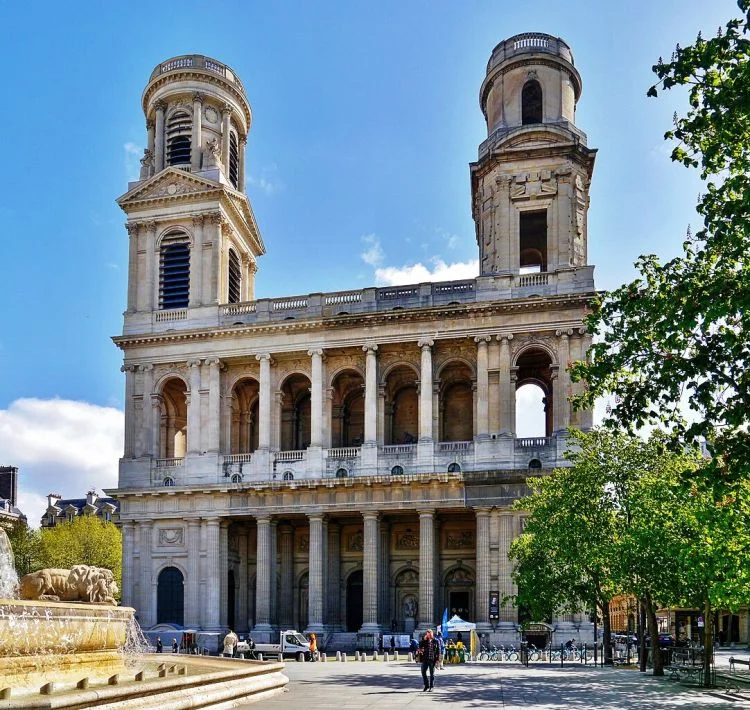
This grand Roman Catholic church, second in size only to the famed Notre Dame, dates back to the 17th century. Its twin towers vary in design, a result of the church’s long construction period, with financial and artistic challenges impacting its final form. Stepping inside, visitors are greeted by a stunning Baroque interior, where light streams through vast stained glass windows, bathing the space in a kaleidoscope of colors.
Église Saint-Sulpice is renowned for its majestic organ, boasting 6,588 pipes, which is one of the largest organs in existence. Beneath its soaring nave, one finds an intriguing gnomon, a scientific instrument designed to predict equinoxes and solstices, integrated into the church for scientific and religious observance.
The church’s history is entwined with tales of intrigue and mystery. It once served as a shelter for aristocrats fleeing revolutionary turmoil during the late 18th century. The church has been the setting for several novels. Literature enthusiasts may also recognize Église Saint-Sulpice as featured in Dan Brown’s bestseller, "The Da Vinci Code," contributing to its air of mystique. Unfortunately in 2005, while filming The Da Vinci Code, Ron Howard was denied permission by the Archdiocese of Paris to shoot inside Saint-Sulpice.
Legend has it that a hidden relic, lost to the sands of time, lies somewhere within its hallowed walls. Several renowned figures have connections to the church, including Marquis de Sade’s baptism and writer Victor Hugo’s marriage.
Photo: Zairon, Wikimedia Commons
48.85098, 2.33501